Podcast: Play in new window | Download (Duration: 26:54 — 37.1MB) | Embed
Subscribe: Apple Podcasts | Spotify | Amazon Music | Android | Pandora | iHeartRadio | RSS | More
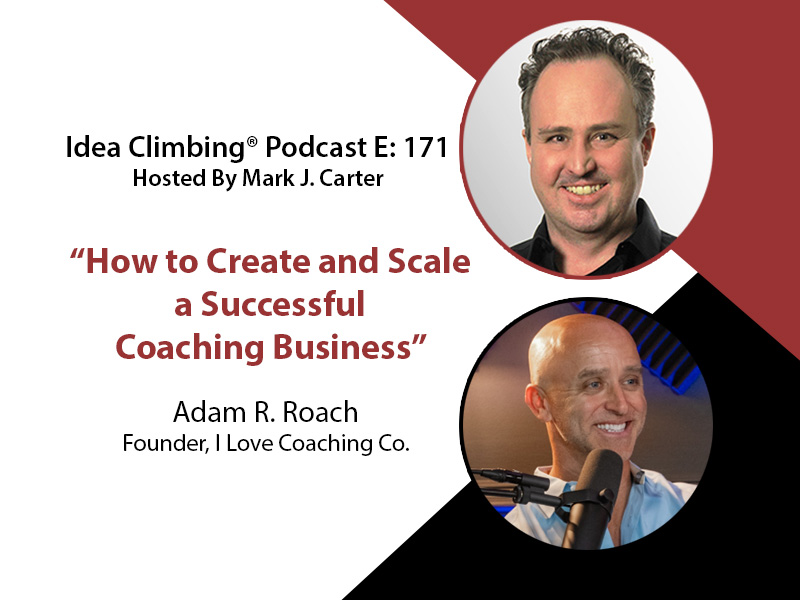
Creating and scaling a successful coaching business is a science and an art form. I discuss how to do that today with my guest, Adam R. Roach.
Adam who helps proven coaches and leaders turn their experience into a real, profitable coaching business through the REAL Coach Method with no certifications or complicated funnels required.
We dive into topics and answer questions including:
- Adam’s origin story in the coaching world.
- The two things that your coaching clients crave and how to create them.
- How do you start building your own tribe(s) of clients?
- The four phases of Adam’s successful coaching blueprint and how to implement them.
- What are the biggest mistakes most coaches make and how can you avoid them?
- The three questions you must ask and answer to successfully build your ideal client avatar.
- Why you can’t chase success and significance at the same time.
- How to engage in making emotional relationship deposits instead of just withdrawals so that people will be drawn to you.
- What challenges come with going from one-to-one coaching to one-to-many coaching and how can you overcome them?
- Suggestions for how coaches growing their businesses can keep on keepin’ on during challenging times.
- The three components of transformation that happen when you successfully create and scale your coaching business.
- Why taking on the next level of scaling a coaching business becomes a personal choice; not a one size fits all answer.
- The one thing, above all else, that you have to do to successfully create and scale a coaching business…
…and other golden nuggets of advice!
Adam’s Origin Story with Creating and Scaling a Successful Coaching Business
At the end of the day, “scale” is an interesting word, because it’s a buzzword out there, in the coaching world. But what does scale even mean? Everybody’s going to have their own unique definition of scale. You can look to scale time, you can look to scale money, you can look to scale, systems, resources and so on.
There’s many different thought processes that need to go into scale. When a coach comes to Adam and says, “I want to scale my business,” the first thing he’s going to ask them is: “Where do you want to add scale?” Because at the end of the day, Adam prefers to scale time. He’s a time guy. He was coached by Dan Martell back in the days when he was writing his book “Buy Back Your Time”, so maybe that’s why Adam’s a time guy, but let’s really look at what time means.
When Adam got into the coaching space, he loved it. He was coaching people one-on-one. He had exited three franchises at that time. He had a SAAS company that he was running at the same time. He was able to coach people into a good value add for their business. Now, here’s what happened though, Adam got to about $50,000 a month of recurring revenue from all these clients that he was coaching. 35 of them at about $1,500 a month and what he loved turned to hate, because for him to increase his revenue, he had to decrease his available time, meaning he had to give up more time.
And so it was at that point in time, of how to make $50,000 and keep all your hair, right? Because at the end of the day, it’s like, what do you want to scale? Money, time or resources?
That’s what Adam had to ask himself when he got to that point of $50,000 a month with 35 paying clients. Life was fantastic, but he had no personal life. That’s not good. He’s been married once and he’s married again. Adam doesn’t want to get divorced twice, because at the end of the day, number one, it’s too expensive, and number two, he loves his wife.
And number three, if, if we’re not with them though, they’re going to be upset. Your family’s going to be upset. So, Adam had to go down the path of scaling his time.
So where did the course correction start for you with scaling time?
There, there was frustration.
It started there. One, Adam had to identify his frustration. Two, he had to identify his fear. What was causing him not to lean into this space of scaling time? The fear was he wouldn’t have the same amount of revenue. And so he had to take a step back and examine his situation.
Adam believes most people at that time would probably say, “Oh, Adam, all you have to do is just create a group coaching program, and then put everybody into that container and charge them a lesser amount, and now you’ve got this magical time back.” That’s not what he did. That’s not how he suggests you do it. Adam had to lean into that fear first and identify where he was most afraid.
What was he afraid of? For Adam it was revenue because he was defining success of his own self at that moment in time in the dollars and cents space. So, he had to look at that and say, “All right. If my fear is in the money, can we create another mechanism where I can provide value, sure, in a one-to-many space-” And still keep revenue at the same amount or greater with less time being put into it?”
Now if we look at, Adam calls it a one-to-many approach. One to many can be a cohort, one to many can be a community, one to many could be a group coaching program, and so on. This podcast is a one to many. Adam and I are speaking and there are many people listening. Keynoting is another example of one to many.
Adam had to understand what container, what mechanism did he want to choose to establish, to create, to systematize with one to many? For Adam it was the community path, so he built a community.
How did Adam stop trading time for money with one-on-one and start building a community?
Adam had to go back to why build a community first. First of all, he likes cohorts. But in his opinion around the cohorts is that they’re a start and a stop, so you always have to be launching new ones.
If you’re not a good launcher, then that’s going to create stress. Okay, so that’s one. Keynote speaking is something Adam has done successfully many times, though he didn’t want to be on the road that much.
Adam believed there was too much travel there. He does love podcasting, so that isn’t something that he’s stopped. But the community, selfishly, is how that came about. It became about wanting a community because he was building in a silo. Adam was building his coaching business in a silo. That had to stop
Adam decided to build a group of coaches and help them build their businesses. That was where he started. He wrote a white paper in 2020 and called his community a “tribe”. It was a tribe of coaches back in the day, and the very top line of this white paper said, “The tribe of coaches known around the world“.
And that’s just the beginning of the story.
Listen to or watch this interview for the rest of the story and more golden nuggets of advice!
You can get my book here: “Idea Climbing: How to Create a Support System for Your Next Big Idea”

About My Guest

Adam R. Roach is the founder of I Love Coaching Co., where he helps experienced leaders build coaching businesses that are real, profitable, and built to last — no certifications or complicated funnels required.
Click here to learn more about Adam’s business!
Want to learn more about scaling your business? Check out “How to Scale from Solopreneur to Entrepreneur with Aaron Scott Young”