Podcast: Play in new window | Download (Duration: 30:39 — 42.2MB) | Embed
Subscribe: Apple Podcasts | Spotify | Amazon Music | Android | Pandora | iHeartRadio | RSS | More
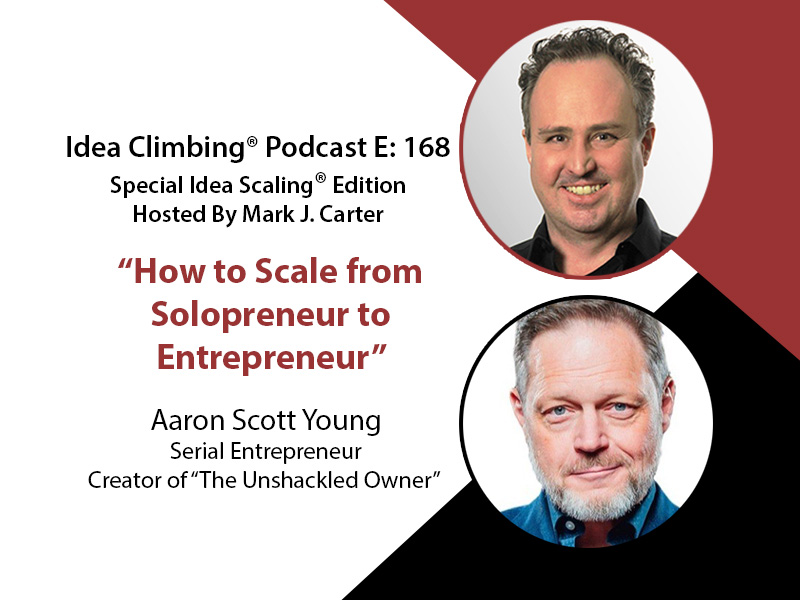
Growing from entrepreneur to solopreneur can be an arduous task. You need to take yourself out of everyday operations and build a team. I discuss how to do that in this episode with my guest, Aaron Scott Young.
Aaron is a lifelong entrepreneur, trusted advisor to CEOs and business owners, and creator of The Unshackled Owner — a proven framework for entrepreneurs who want to build a real business, not just a glorified job.
Aaron is Chairman/CEO of Laughlin Associates, a 44-year-old company that has helped over 100,000 entrepreneurs start, grow and profit from their business. This has given Aaron an ideal vantage point to observe common mistakes and successes in businesses from Main Street to America’s largest yacht broker from medical professionals to manufacturers to investors.
We dive into topics including:
- Aaron’s origin story for successfully scaling from solopreneur to entrepreneur.
- Why the principles of scaling are the same regardless of the industry.
- The reasons it can be difficult to scale as a solopreneur.
- The starting point of scaling from solopreneur to entrepreneur.
- Why it’s important to get explicitly clear about what you want from your business.
- The next step after you decide what direction you want your business to move toward.
- How to figure out what types of people you need to find to build your team.
- How to create exponential growth by growing from solopreneur to entrepreneur.
- What exponential growth means psychologically to you as an entrepreneur.
- The three things a business needs as a foundation to become successful.
- How and why plateaus happen when scaling and how to embrace them.
- Why growth is a lifelong process, not a final destination.
- The one thing, above all else, that you need to do to scale from solopreneur to entrepreneur.
…and other golden nuggets of advice!
Aaron’s Entrepreneur Origin Story
Aaron started his first business as a teenager in 1982 and when it started, he didn’t even realize he was starting a business. Aaron was just trying to make some money for Christmas presents. He borrowed a truck, knocked on people’s doors, collected old musty newspapers, and took them to the commercial recycling plant down in the industrial area of Portland, Oregon.
Aaron learned how to recycle newspapers and other materials in the Boy Scouts while participating in fundraisers. This was before recycling was mainstream. He made a fair amount of money. That was during his freshman year of college (his only year of college at that point) and he made several thousand dollars in a short time. He went back to school but thought, “Ooh, there’s something here.”
When Aaron came back home from school in April of 1983, he mapped out the city, and came up with some flyers and route books so that he could write down all the addresses, so he knew what to do and where to do it.
He started canvassing the city of Portland, and in short time ended up with about 5,000 homes on his route and two trucks, four guys, and they were picking up old newspapers.
Then they figured out other things they could pick up that they could sell. They ended up doing odd jobs, cleaning gutters, hauling junk, and things like that because they had trucks. And then, because Aaron grew up in the Mormon Church and as a young Mormon man you’re supposed to leave and go on a proselyting mission.
Aaron had just gotten back from school in April and left on his proselyting mission in September. During that short five-month window Aaron and his team built out the routes and got the trucks going. When Aaron left again the business kept going. While he was on his mission Aaron still got paid. The business still provided a financial upside for him.
An Amazing Entrepreneurial Lesson Learned
a 19-year-old Aaron learned he could own something that paid him that he didn’t have to be there for to supervise or do the physical work. Then he met this cute girl, and he wanted to get married after he got home from his mission. Aaron thought, “She’s not going to want to be married to a garbage man”.
Aaron sold the business when he was 22. He didn’t know that made him an anomaly as a 22 year old. He let the business go and made some good money. Then he bought an inventory of cellular telephones, and in 1986 Aaron became one of the first cellular phone dealers in the Northwest. Aaron ended up with multiple locations and he couldn’t be in multiple locations at once to do everything so he had to scale.
Eventually Aaron had a couple dozen salespeople. He couldn’t be with them on every sales call. Because of that he had to develop systems so that everyone could be managed. There were people in the field, people at locations and people doing the installations and such. He had to figure out all those logistics to stay profitable.
Six years went by, and that all changed. The cellular phone industry changed from individual owners like Aaron to big box retailers in 1992. With one fell swoop the big box retailers yanked the rug out from under the smaller resellers. So his business closed and Aaron had to figure out something else to do.
A New Trajectory
At 29 years old Aaron got asked to lunch. The man who invited him asked Aaron, “Would you be open to having a job?” Aaron asked, “What’s the job?” The response was, “Well, we have a financial services company, with around 350 offices worldwide. Our home office is here in Portland, and we’d like you to be our Vice President of sales.”
Aaron said, “So manage sales for Portland?” The response was, “No, for all 350 offices.” Aaron thought, “What kind of rinky-dink company’s going to hire me?” He had little education. He just had a business that closed unexpectedly. Long story short, Aaron took the job and he quadrupled sales and the company went public on NASDAQ while Aaron was the Vice President. He was there three and a half years.
Aaron made some great money when the company went public. It was not his dream to be in financial services. He once again had to find a new adventure. Aaron started buying companies. And that’s what he’s been doing, buying and fixing companies ever since then. One thing that he learned along the way was that you can own something remotely, you can have multiple locations, you can have an expansive global network, and the fundamentals for operations are the same for each situation.
The scale is bigger, the service is different, but the operational part is basically the same. Aarons learned about SRA, “the Same Rules Apply”. When you learn the rules, you can apply them in a variety of ways and at differing scales, and it doesn’t matter about the industry because the principles are the same.
You need to learn and understand how those principles work if you want to scale from solopreneur to entrepreneur. You can own a myriad of assets that are working for you without being the most critical employee in those companies.
And that’s just the beginning of the story!
Watch or listen to this episode for the rest of the story and more golden nuggets of advice!
You can get my book here: “Idea Climbing: How to Create a Support System for Your Next Big Idea”

About My Guest

Aaron Scott Young is a lifelong entrepreneur, trusted advisor to CEOs and business owners, and creator of The Unshackled Owner — a proven framework for entrepreneurs who want to build a real business, not just a glorified job.
Aaron is Chairman/CEO of Laughlin Associates, a 44-year-old company that has helped over 100,000 entrepreneurs start, grow and profit from their business. This has given Aaron an ideal vantage point to observe common mistakes and successes in businesses from Main Street to America’s largest yacht broker from medical professionals to manufacturers to investors.
For over 34 years, his experience founding, acquiring and directing multi-million dollar businesses as well as working as an officer for a publicly traded, multi-national, sets him apart from the crowd as a voice of real world knowledge and authority.
Aaron has made it his life’s work to arm other business owners with success formulas that immediately provide exponential growth and protection.
Click here to learn more about Aaron!
Click here to connect with Aaron on LinkedIn!
Want to learn more about the entrepreneurial mindset? Check out “How to Create a Successful Money Mindset with Chris Jarvis“