Podcast: Play in new window | Download (Duration: 27:53 — 38.4MB) | Embed
Subscribe: Apple Podcasts | Spotify | Amazon Music | Android | Pandora | iHeartRadio | RSS | More
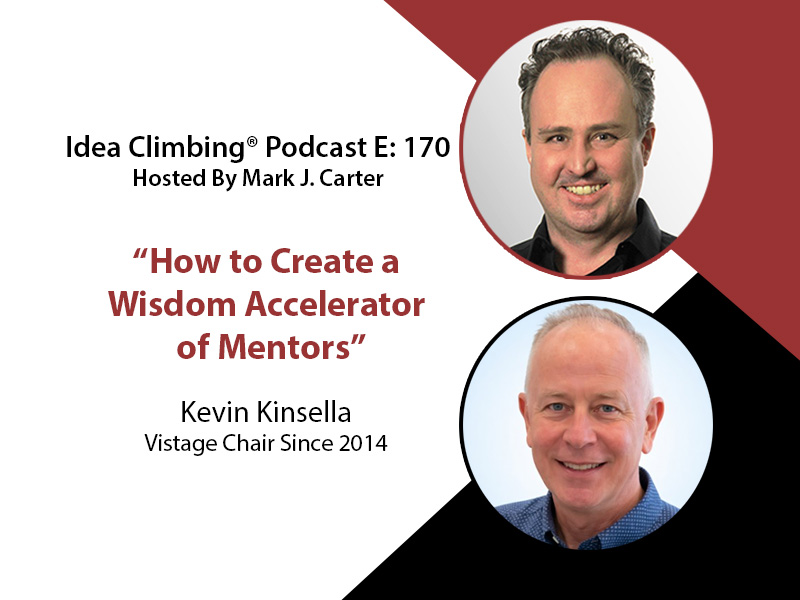
Why try to figure things out when you can get help along the way? Too many entrepreneurs try to be lone wolves when help is just an email or phone call away. I discuss how to create a Wisdom Accelerator of Mentors in this episode with my guest, Kevin Kinsella.
Kevin’s formal education (starting as a CPA and then his UC Booth MBA) was geared toward big business. He quickly pivoted into small business in his 20’s, however! Since founding his first business (#59 on INC. Magazine’s 500 Fastest Growing Companies in 1991), to today having coached and advised 100+ small business owners (over the past decade), he is forced to be state-of-the-art to best support his ever-aspiring entrepreneurial owners.
We dive into topics and answers to questions including:
- Kevin’s origin story in the entrepreneurial world.
- Why is the need for vulnerability so important if you want to learn and grow faster than you could alone?
- How do you begin reaching out to potential mentors to learn from their wisdom and life experiences?
- Why does technology like AI makes it even more difficult to learn faster?
- Why are people, especially entrepreneurs, afraid to be vulnerable?
- Why do entrepreneurs need to be resilient to stay the course?
- Why do other people try to bring you down or encourage you to give up?
- What are some of the benefits of being vulnerable?
- Why is understanding that people just want to be heard such an important business tool?
- What are qualities to look for in a mentor?
- Where do you go to find mentors?
- What does approaching people for help or mentorship look like?
- How do you have meaningful mentoring conversations?
- What do meaningful mentoring conversations look like?
- What questions should you ask your mentors?
- Why don’t many entrepreneurs want to be held accountable?
- What are the ingredients to becoming a successful entrepreneur?
- How do you drive a mentoring relationship forward after your first conversation?
- How can you help your mentors and give back to them?
- Why do people need to be taught to ask better questions?
- The one thing, above all else, you need to do to create your own Wisdom Accelerator Program of mentors.
…and other golden nuggets of advice!
Kevin’s Wisdom Accelerator and mentorship origin story
Kevin’s been fortunate enough to be an official business coach for 12 years, but unofficially for probably 40 years.
His first 30 or so years he thought you got extra points in life for figuring things out alone. It was a badge of honor. Kevin thought that there was a lot to be gained by working harder. That’s because that’s how he was raised. He says he shouldn’t blame his mom, but he will, because she’s not here to defend herself.
You just work harder, you work longer, and you figure it out, and if you need help, you’re weak. Kevin now realizes that’s not a good way to live. About 15 years Kevin was introduced into the world of professional business coaching. He realized that you could save years, even decades of time by borrowing other people’s wisdom. That’s the genesis of Wisdom Accelerators that we’re going to talk about in this episode.
When did you, when did you realize that it’s not weakness to want advice, coaching, support, things like that?
Kevin is 65 and says that he probably realized this new view on mentorship and sharing knowledge around age 53. He also believes that if he had picked it up when he was 32, we wouldn’t be talking today. He’d be on an island somewhere sipping a drink with an umbrella in it.
The concept of not understanding that sooner was a shame for him personally. Today he gets the joy of helping other people accelerate their learning and learn those things when they’re in their 20s, 30s and 40s. That way they can live the rest of their lives doing things that are more interesting, more exciting, and further enriching. That’s because they don’t have to learn the lessons alone because they’re learning them from others.
How can mentors help you avoid mistakes and downturns in life?
Kevin believes it was more empirical observation in terms of what he saw doing for others rather than him taking the step and asking for the help of others.
Kevin thinks of it as the inverse of not having used it. Kevin spent his 20s preparing for the business world. Kevin earned his bachelor’s degree in Accountancy from the University of Illinois Urbana-Champaign and his MBA in Marketing and Finance from the University of Chicago. He planned to become an investment banker, and he quit early on to be an entrepreneur because he thought he knew better than everybody else.
Kevin built a firm with friends during his 20s, and they were number 59 on the Inc. 500 fastest growing company list in the country in 1991. That’s back when there was only 500 on the list instead of 5,000.
Kevin spent his 20s growing that firm while not understanding some basic components like tracking profitability and focusing on repeat customers.
Unfortunately, that part of Kevin’s journey ended very tragically. He had to liquidate the company when an angel investor pulled the plug on him and his friends. Despite having 120 employees, the angel investor was uncertain about the economy and he said, “I want you to liquidate it.” A whole decade of Kevin’s life was gone in a week.
Kevin believes if he had a board or someone else to guide him along the way, he probably wouldn’t have fallen into that situation. But he did learn some really hard lessons, and also fell in love with small business at the same time. Kevin got addicted to life in the small business world. But the lessons, if he would’ve had somebody, if he would’ve had an uncle or just a trusted advisor it all would have done differently. But he didn’t have that person in his life.
Kevin thought you just work harder and try harder. Thankfully, Kevin eventually learned there’s other ways to go about life in the small business world.
What is the most important thing you need to know when reaching out to potential mentors?
The first thing you must do is you to be willing to be vulnerable and admit you don’t know everything. When Kevin made the Inc. 500, he thought he knew everything about every business topic known to man.
Being willing to realize that you don’t know what you don’t know is paramount. Kevin meets and helps a lot of people today. He mentors people through his association with Vistage, the world’s largest CEO organization.
Kevin would say two out of three people that he meets are not good Vistage candidates because they think they’ve got all the answers already. But when it comes to being a successful entrepreneur and CEO the vulnerability component is a huge part of it. Being willing to be humble and realize there’s a lot that you don’t know can make or break you.
There’s just so much to learn. And there’s more to learn now than ever before. It’s even more challenging, because of all this technology and things like AI that are developing at such a brisk pace. You need to accelerate your learning in a time when it’s never been faster, flowing more quickly than we realize.
And that’s just the beginning of the story!
Listen to or watch this episode for the rest of the story and more golden nuggets of advice!
You can get my book here: “Idea Climbing: How to Create a Support System for Your Next Big Idea”

About My Guest

Kevin Kinsella is a Chicago-area entrepreneur, executive coach, mentor, and longtime Vistage Chair who has spent his career helping business owners and CEOs make better decisions, grow their companies, and become stronger leaders.
Kevin brings firsthand entrepreneurial experience to his work. He has served as a founder, owner, president, and business development leader, and he founded a company that earned a spot on the Inc. 500. He has also helped develop and execute growth strategies for startup, small, and mid-sized businesses.
Since becoming a Vistage Chair in 2014, Kevin has led and coached peer advisory groups of Chicago-area business owners and CEOs. His work combines one-on-one coaching with the collective wisdom, experience, and accountability that come from putting accomplished leaders in the same room. Kevin has been recognized as a top-performing Vistage Chair for three consecutive years—2023, 2024, and 2025—for member acquisition and retention.
Connect with Kevin on LinkedIn!