Podcast: Play in new window | Download (Duration: 26:54 — 37.1MB) | Embed
Subscribe: Apple Podcasts | Spotify | Amazon Music | Android | Pandora | iHeartRadio | RSS | More
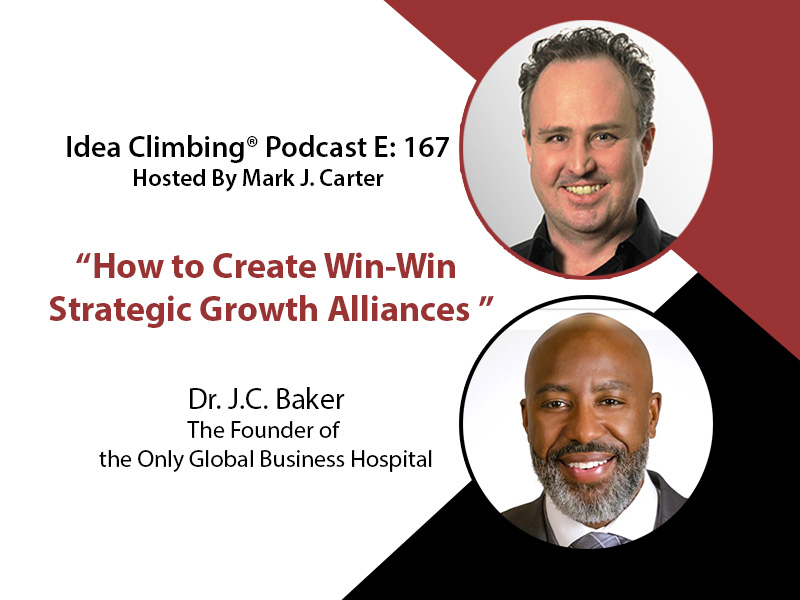
Your business can’t operate in a vacuum; you need win-win strategic growth alliances to grow faster than you could alone. It’s one thing to say win-win; it’s another thing to successfully create those situations again and again. I discuss how to do that in this episode with my guest, Dr. J.C. Baker.
Dr. Baker has invented the standard for Business Health and has dedicated his life to reducing business morbidity. He is the Founder of The Business Hospital, and The Business Hospital Institute. The Business Hospital is the only one in the world operating in 15 countries.
Dr. Baker is a Doctor in Business Administration with a focus on Organizational Leadership. Dr. Baker is a six-time and #1 Best-Selling author with textbooks on how to launch a business and how to make good business decisions.
We dive into topics including:
- The growth of The Business Hospital through strategic growth alliances.
- The problem with being too selective when it comes to who you network with and take meetings with.
- The art and science of asking the right questions at networking events.
- Examples of a series of meaningful questions to ask in different networking scenarios to uncover potential mutually beneficial alliances.
- How to bridge the gap between just giving help but also getting help at the same time.
- How to create,structure, and foster ongoing mutually beneficial strategic growth alliances.
- The importance of a CRM and how to use it to maintain and build strategic growth alliances.
- How to ask for help or referrals without coming across as pushy.
- What to do when an initially win-win strategic alliance becomes a one-way street.
- How to be discerning in the relationships you build without becoming transactional.
- How to know if and when you have enough strategic alliances to scale back your networking initatives.
- The one thing, above all else, that you need to do to create win-win strategic growth alliances.
…and other golden nuggets of advice!
Dr. Baker’s Origin Story with Strategic Alliances for The Business Hospital
Dr. Baker has built The Business Hospital’s entire practice through strategic alliances and with strategic partnerships. Dr. Baker wants to clarify for language purposes that partnerships, in his mind, mean legalities, so therefore, those are binded relationships that have a legal ramification. Alliances are collaborations, activations, campaigns, or connections that you have with other entities.
The Business Hospital has been able to grow to 15 countries on five continents because of those alliances and some of those partnerships, because you need other entities in order to expand your reach, create additional expertise or offerings that you may not have, or even have people walk you in the proverbial business doors that otherwise would have been unknown to you.
Alliances have been critical for not just The Business Hospital’s growth, but even the work they do with their business patients.
Where Does Building Strategic Alliances Start?
Dr. Baker’s philosophy does not mirror what he’s heard from most people, especially in the United States. You’ll hear a lot of gurus say, “Guard your time. Be very selective in who you meet with.” He doesn’t agree with that way of thinking. He says yes to everything, because you never know what you’re going to find, who you’re going to find, how you’re going to help someone, and how someone may help you.
So you have to be smart with how you navigate your time, but you also have to open yourself up for the opportunities to be there. And they come from a lot of unlikely places. So, when you say, “Where does it start?” It starts a lot of places. It starts with networking events. It starts with Chamber of Commerce events.
It starts with invites to certain opportunities and events when the other person says, “You know what? You’re a person that I’ve been trying to get ahold of, and I would love for you to come support me at such and such event.” You should say yes to that, because when you get there if you ask the right questions and you present yourself appropriately, those opportunities for the right alliances will start to manifest themselves.
And then you get better over time with how to present how you show up in order for someone else to see you appropriately and say, “You know what? I know exactly what I should be doing with Mark or with company ABC or with the business hospital.” And then you can also say, “You know what? I see what you’re into, and guess what would help you?” because you’ve had that practice of having that dialogue in so many different areas.
How do you know what kind of questions to ask when you get into different networking scenarios?
It’s very unique that Dr. Baker actually teaches question asking and probing when he’s working with his business patients.
Most of the time the conversation falls under the realm of sales, because when you think about sales, most people think it’s about the information you give. But it’s more about the information you receive based on what questions you ask. So the way that you go about probing is going to help you understand, one, how to position yourself, and then two, how to provide value to whomever you’re probing.
In other words, there’s a couple ways of doing that. It’s more technique at this moment. But you’ve got the probing questions that you learned when you were in elementary school: Who, what, when, where, why, and how. Dr. Baker believes we have to revisit those and say: How am I placing my who, what, when, where, why, and how?
An Example of a Series of Networking Questions to Ask to Uncover Potential Alliances
For an example, if you just met someone at a networking event, or you’re at a seminar or conference, and one of the “whats” is,”What do you do, Mark?” Well, Mark’s going to tell you. Then you need to be listening with a very intent ear. And you’re not listening just for the sake of listening.
You’re listening to learn how you can help them. Not how you might make money from them. How do you help them? Because if you understand how to help them, you can see where your skill sets match theirs, or maybe your resources or your network can benefit the other person. So that’s a simple “what”. Very easy question.
Then you move onto your second level probing questions, and your second level probing questions are very much like those of a therapist. Those start with verbiage such as “walk me through, explain to me, paint me a picture, tell me a time when”. When you start your questions that way, and you say, “Mark, paint me a picture of what it is that you would really like to get done over the next three to four months. What does that look like?” And they tell you that, and you find out whatever they say fits into your wheelhouse, you now know that you can bring you value.
And that’s just the beginning of the story!
Listen to or watch this episode for the rest of the story and more golden nuggets of advice!
You can get my book here: “Idea Climbing: How to Create a Support System for Your Next Big Idea”

About My Guest

Dr. J.C. Baker is the founder of The Business Hospital(R), and The Business Hospital InstituteTM. The Business Hospital(R) is the only one in the world operating in 15 countries. Dr. Baker is a Doctor in Business Administration with a focus on Organizational Leadership.
Dr. Baker is a six-time and #1 Best-Selling author with textbooks on how to launch a business and how to make good business decisions. He has invented the Business Health IndexTM and Investment Health IndexTM used to successfully treat thousands of businesses.
Click here to learn more about Dr. J. C. Baker’s Business Hospital!
Want more business building advice? Check out “How to Successfully Build and Scale Your Service Business with Rick Elmore“