Podcast: Play in new window | Download (Duration: 26:09 — 36.0MB) | Embed
Subscribe: Apple Podcasts | Spotify | Amazon Music | Android | Pandora | iHeartRadio | RSS | More
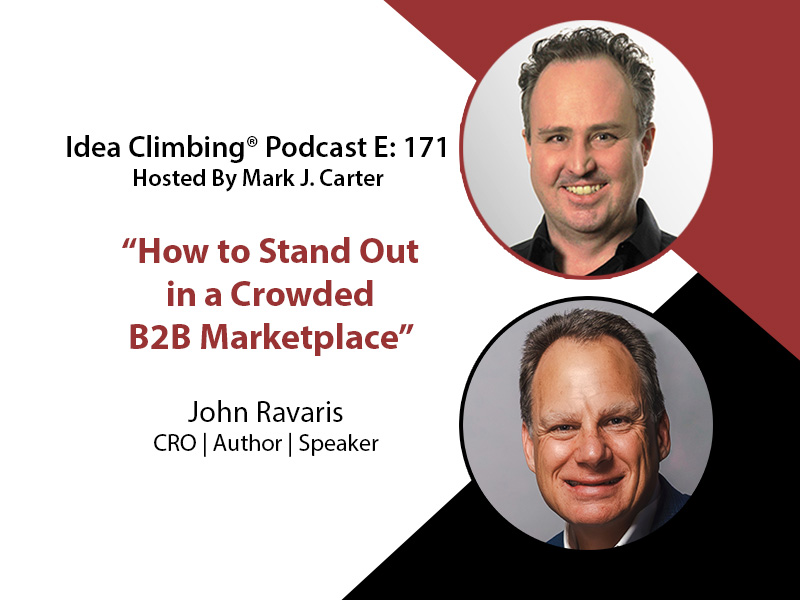
Differentiating your service business and standing out in a crowded B2B marketplace can be tough. Today I am discussing how to do that with my guest, John Ravaris.
John is the founder of UVPsolutions®, creator of the proprietary 4D Roadmap®, and author of “Define Value, Drive Growth”—all dedicated to helping small and medium-sized businesses differentiate, define their unique value, and drive growth.
- Josh’s origin story about his passion for differentiation.
- Where do you begin when you set out to differentiate yourself and your business?
- How do you discover and connect your business with a bigger purpose in life?
- How do you combine your culture and values to become the cornerstone of the strength of your business?
- The concept of “strength buckets” and how to find and fill yours.
- How do you create a purpose for your business and further differentiate your business in the marketplace?
- How do you develop go-to market strategies by embracing your differentiating principles?
- The importance of connecting your organizational strengths to what your clients and prospects are trying to achieve.
- The importance of value creation when creating a growth plan for your business.
- Why does problem solving for your clients and prospects need to be a focus point to successfully differentiate yourself?
- How problem solving and success factors need to be woven together in your offerings to create lasting value.
- How to best stand out and differentiate yourself even in saturated markets.
- Why we’ve graduated from selling features to selling benefits and now from selling benefits to selling outcomes.
- Why 70%-80% of the buying decision is made before the prospect interacts with your organization and how to use that to your advantage.
- How to find out what outcomes your prospects want from your company and then how to deliver them.
- How to sustain differentiation in your marketplace once you’ve achieved it.
- The key component to continued growth as you gain momentum in your marketplace.
- Why “what got you here won’t get you there” and the need to be ready to pivot and change as you grow.
- The one thing, above all else, that you need to do to successfully differentiate yourself in a crowded B2B marketplace.
…and other golden nuggets of advice!
How did John discover the importance of differentiation?
When John discovered his passion around differentiation, unique value propositions, the title of his book “Define Value, Drive Growth”, it really was a passion around ensuring that you’re able to articulate why you’re uniquely different and why a client or prospect should care about your product and service over somebody else’s.
What’s interesting is the importance of differentiation has grown as technology has expanded, as sound bites have gotten shorter, and as less words have been used. The quality and capability of that message, and the ability to communicate it competently with clarity, with articulation in a short amount of time, whether it’s in written space, on video, a website, wherever it is, is more paramount than ever.
So that ability to differentiate has gotten more difficult, and Josh’s passion around being able to help small to medium sized businesses do it has only grown.
When it comes to differentiating your B2B business, where do you even begin?
Josh is a big proponent of starting from the cultural perspective of differentiation. He’s a big proponent of starting with who you are as a business around the values and foundation of what your business stands for and how your business operates and executes. From there you move into the purpose component, which is why do you do what you do?
Many people have businesses, but there needs to be a deeper meaning to that business. For example, if your business is selling industrial cleaning services, for example, a good, noble task, something that people need. But most people around that have a bigger goal in their business around that. It usually is around people, creating opportunities for people, creating opportunities for growth in people.
That’s an example of an industry that has a large immigrant population, has a low barrier to entry, so if you get into it and you’re skilled at what you do, you can grow into a career from a frontline cleaner to a director to a vice president of operations IF the owner’s goal is to better his employees’ lives. Many people have an important purpose around their business, and Josh believes more than ever, when you’re talking to prospects or clients are doing business with you, they want know that cultural piece.
They want to know that value piece, that core value piece, who you are as an organization. More than anything, they really want to know why you do what you do. If that aligns with them from an emotional perspective, that intangible perspective, Josh believes it’s really meaningful in today’s marketplace and really important for businesses to articulate and start their differentiation there.
How can entrepreneurs connect to their purpose?
“Purpose” means a lot of things to a lot of people. John likes his simple definition of purpose.
That simple definition sometimes is would you do what you do if it wasn’t for the money? If it wasn’t a business that created economic value, would your business still do what you do? Or would your business feel as though it was important to do what you do? For example, when you think about purpose at a larger level, you think about not only the product and/or service that you are delivering, but you think about the connection or the outcome of what your product or service provides either for your employees, your clients, or very often the communities of which we work and we serve.
Once you find your purpose, how do you start marketing it?
What Josh likes to say is that purpose, that culture, those values become a cornerstone of the strength of your business.
When you’re looking at your business as a whole, that’s a component of the strength of your business. As you know, businesses sometimes have other capabilities, whether it’s around technology or knowledge bases or some other components around the core of the business. And then they also have business strength as well, things such as fast delivery, better inventory, higher customer service.
So when I think about a business, I think about those things in strength buckets, if you will. One of those strengths buckets is those foundational components, your purpose, your culture, your core values. There’s also a strength bucket in who you are as an organization, the knowledge base that you have, the competencies that you have around what you do and so on. Then there’s a strength bucket around how you do what you do and how you execute your services.
Those together become what Josh likes to call is your holistic strength bucket. When you start talking about differentiation, you should always start with your organizational strengths, those cultural and foundational components matched with unique capabilities of your business and important or differentiated go-to-market strategies as the foundation of how we talk about organizational strengths.
And that’s just the beginning of the story!
Watch or listen to the rest of this episode for the rest of the story and more golden nuggets of advice!
You can get my book here: “Idea Climbing: How to Create a Support System for Your Next Big Idea”

About My Guest

John Ravaris is the founder of UVPsolutions®, creator of the proprietary 4D Roadmap®, and author of Define Value, Drive Growth—all dedicated to helping small and medium-sized businesses differentiate, define their unique value, and drive growth.
Known for his ability to transform vision into execution, John turns fragmented insights into clear, practical strategies that become embedded in organizational culture. He is driven by one belief: “Neither your industry nor your competition defines your business or the value it creates—only you can do that.”
With more than 35 years of leadership experience in marketing and sales across manufacturing, distribution, service industries, and private equity John has built his career inside family-owned businesses ranging from tens of millions to hundreds of millions in revenue. This deep experience has given him a firsthand understanding of the unique challenges and opportunities of helping businesses thrive and sustain long-term growth.
A servant leader at heart, John believes in building lasting legacies, inspired by the Greek proverb: “A society grows great when old men plant trees whose shade they know they shall never sit in.”
He holds a Marketing degree from the University of Maine and an MBA from Saint Joseph’s University.
Click here to learn more about John’s business!
Click here to connect with John on LinkedIn!
Want to learn more about B2B entrepreneurship? Click here to check out “How to Maintain Your Sanity While Growing a B2B Business with Mark Hartmann”

