Podcast: Play in new window | Download (Duration: 28:13 — 38.9MB) | Embed
Subscribe: Apple Podcasts | Spotify | Amazon Music | Android | Pandora | iHeartRadio | RSS | More
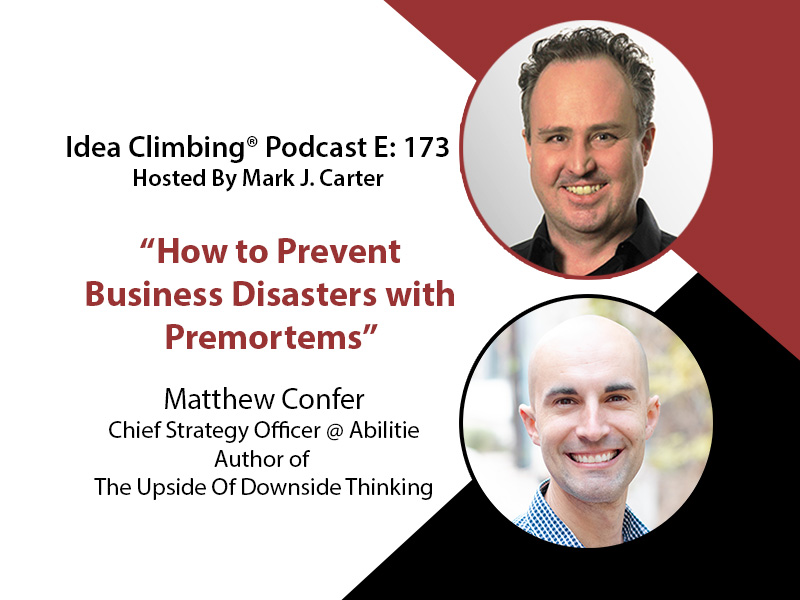
Most business disasters can be prevented but most businesses go about it the wrong way. Almost everyone has heard of a postmortem; but what about a premortem? We define what premortems are and how to conduct them in this episode with my guest, Matthew Confer.
Matthew is the Chief Strategy Officer at Abilitie and the author of The Upside of Downside Thinking: A Premortem Approach to Better Decision Making, published by ATD Press. His 2019 TEDx talk, Before You Decide, has been viewed more than one million times and helped spark his years-long exploration of how premortem thinking can help us make better decisions. He is also the host of the Learn to Lead Podcast.
We dive into topics and answers questions such as:
- Matthew’s origin story with premortems.
- The RISK model for premortems.
- The difference between a postmortem and a premortem and the benefits of adopting the latter.
- The theory of the domino effect and how it can affect your business.
- How can you stop the negative results of the domino effect in your business?
- The power of brainstorming sessions to recognize potential threats.
- How do you address potential threats once you recognize them?
- What are “warning triggers” and how do you embrace them to avoid disasters?
- What is “analysis paralysis” and how can you avoid it?
- Why do you have to name your risks when you are brainstorming?
- While your analyzing potential failures, how do you get past “freak out” moments?
- How do you put failure safeguards in place?
- How do you give your team and yourself permission to have very difficult conversations while you can still make adjustments or change direction?
- Why is it beneficial for leaders to embrace dissent during those difficult conversations?
- How do you know what warning signs to focus on and create solutions for?
- What are the responsibilities of the “owners” of triggers (potential failures) in the domino effect?
- How do the “owners” of triggers work together to provide cohesive solutions?
- How do you make “pre-emptive strikes” with solutions before the dominoes fall?
- What are the biggest benefits of a premortem?
- The one thing, above all else, you must do to create a successful premortem…
…and other golden nuggets of advice!
Matthew’s Premortem Origin Story
The year is 2018. Matthew’s company does leadership development training via simulation-based games.
They have these executives, these leaders, these entrepreneurs in their simulations all around the world. What they ended up finding out was that many of the teams that were successful were actually not the teams that were abundantly confident and had confidence oozing out of their veins in their early stages. They were actually the teams that said, “If we’re about to make a big mistake, here’s the big mistake we’re about to make.”
Matthew went on a journey looking at decision-making, decision science, and what he ended up finding is that people do a ton of postmortems in their personal life and in their work life. They’re always looking back, and it’s powerful to start at the beginning and say, “What if I’m about to make a huge mistake?”
They ask “What if I do a premortem? What if I can see how this is going to fail?” That led Matthew on a seven-year journey that has led him here today with a book that came out in the fall of 2026; “The Upside of Downside Thinking”.
Where Does a Premortem Begin?
Optimism is this powerful engine. We as a species have succeeded because by our very nature, we’re optimistic, and entrepreneurs probably more so than anybody else. You wouldn’t do things if you weren’t optimistic. While optimism is a powerful engine, its a terrible safety system.
Many times it just exposes your to blind spots left and right, and the whole concept of a premortem is stopping at the beginning and saying, “Okay, if I’m about to make a huge mistake, if this is about to be an unmitigated failure, how would that happen?” Then you visually walk through and viscerally feel the mistake in its entirety.
The big thing that Matthew learned while speaking with leaders, entrepreneurs, and other individuals about this, is that you start to realize failure is cheap when it’s discovered early in the process. If you figure out why something is going to fail, you’re either able to mitigate the disaster around the decision you were going to make or you put safeguards in place so the decision you are going to make is better prepared for the eventual failure that could come up.
That is extremely valuable, and Matthew believes that’s the real power of embracing a premortem.
How Do You Isolate and Prevent Failure with the RISK Framework?
Matthew put together a framework that his team has used with many of the organizations and entrepreneurs that they’ve worked with. It’s called the RISK framework, and it starts with recognizing your threats.
That’s the R; “Recognize”. There are two steps to recognizing the threats. One is you have to decipher what success looks like, so you must define the decision that you’re making. Then it becomes a data dump of all the things that could go wrong. When you do that, you must get beyond the surface level of the problem
Just sitting in a room and thinking, “I might miss the budget” or “I might not hit my sales target” is not actually recognizing the threats. You must get into details such as: What does potential failure look like? What is the threat?
Then you write down ALL your ideas. Get all the threats out there. The second step is “Imagine”; imagining the disaster. You don’t want to just say, “It’s going to be a problem if my supplier can’t come through.” You must walk through the scenario that if the supplier can’t come through, you have a crazy 24-hour period where you’re trying to scramble, then you start to hear from clients that they’re disappointed, and then your numbers go down. Get into the proverbial weeds.
That means you viscerally walk through the disaster. You imagine it playing out.
How do You Prevent Disasters Once You Recognize Them?
Then the third step is “Solve”; when you solve for the vulnerabilities. Now you’ve got all the disasters, and you’ve got all these visceral scenarios that you can feel in your bones about what this risk would look like. Now you must rank them.
You must ask things such as “What are the things that I actually can control? What are the things that would be really damning if they happened to me as an individual, to my business if I’m an entrepreneur?” Then you start to rank them, and you start to say, “What is the thing that I could have done?” Then the final piece of the puzzle is “Kickstart”; you kickstart the solutions.
You ask, “If this failure plays out, what do I wish I would have done two to three days ago or two to three weeks ago, and what can I do now to put that safeguard in place?” You need to put triggers and preventative measures in place. You want to assign somebody to watch them. You want to do what you can so the failures you’ve imagined never come to fruition.
And that’s just the beginning of the story!
Watch or listen to this episode for the rest of the story and more golden nuggets of advice!
About My Guest

Matthew Confer is the Chief Strategy Officer at Abilitie, an Austin-based leadership development company that uses immersive business simulations to help develop leaders around the world. He is the author of The Upside of Downside Thinking: A Premortem Approach to Better Decision Making, published by ATD Press.
The book grew out of ideas Matthew first explored in his 2019 TEDx talk, Before You Decide, which has been viewed more than one million times, and introduces a practical approach to using premortem thinking to uncover blind spots, challenge assumptions, and make better decisions.
Matthew is also the host of the Learn To Lead Podcast, where he explores memorable stories and ideas about leadership, decision-making, business, and lifelong learning.
Check out Matthew’s book, “The Upside of Downside Thinking”!
Connect with Matthew on LinkedIn!
Want more advice for entrepreneurs? Check out “How to Build and Maintain Resilience with Jay Sapovits“